
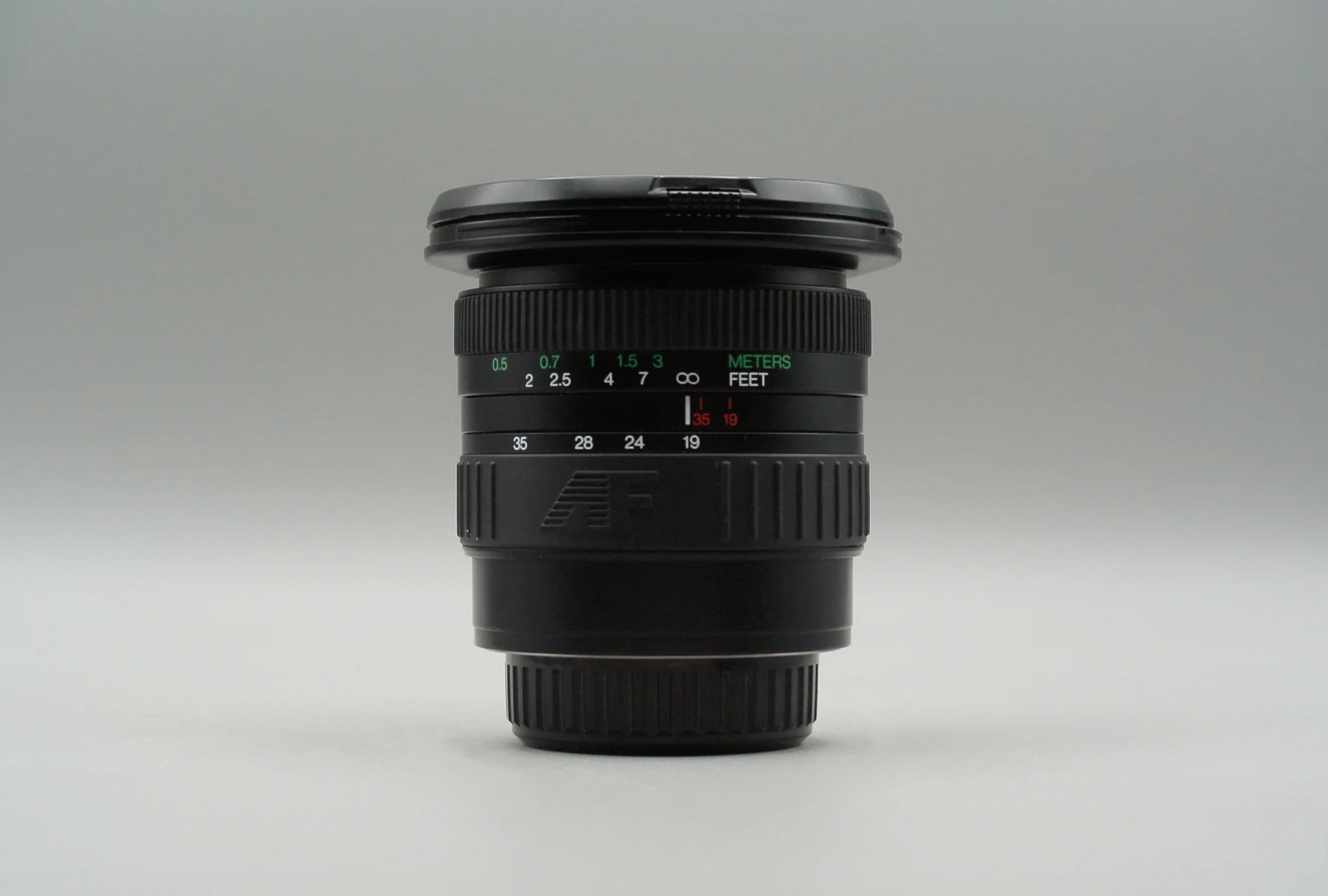
Plastic fantastic or disposable disappointment?

Finding a proper wide-angle lens with a good aperture and without major optical drawbacks has never been cheap. Before we dive deeper, let’s first explain how the terminology works:
Standard lenses, which are closest to human vision and provide a natural perspective, typically fall in the 35–50 mm focal length range.
Wide-angle lenses, which capture more of the scene than the human eye and are well suited for tight spaces, cityscapes, and general-purpose shooting, are usually in the 24–35 mm range.
Ultra-wide-angle lenses capture an extreme field of view and are commonly used for vast scenes, epic landscapes, and architecture. These are generally considered to be lenses with focal lengths shorter than 24 mm.
There is also a separate category called fisheye lenses, which feature extreme distortion and up to a 180-degree field of view, but I won’t be discussing them in this article.
Major camera and lens manufacturers have offered lenses in all of these categories since the mid-1970s. The professional standard was an aperture of f/2.8 (Some even up to f/1.4 such as Nikon 28mm), and these were usually fixed-focal-length lenses at 18, 20, 24, or 28 mm. They were quite expensive when new and have also retained high prices even after a couple of decades.
Now we come to the main question:
Do I really need an expensive professional wide-angle lens if it’s only used occasionally? Do I really need f/2.8, or can I get away with a smaller aperture since I’m using a tripod? Maybe there’s a cheap alternative that covers this focal range?
One such alternative is the Cosina / Vivitar / Promaster / Soligor / Phoenix 19–35 mm f/3.5–4.5.
Why list all of these brand names? Because it’s essentially the same lens sold under different brands. Most were made by Cosina, a Japanese manufacturer, and then rebranded for different markets with only very slight variations—the core design remained the same. These lenses were offered in almost all major mounts, such as Nikon F, Canon EF, Minolta AF, Pentax K, and others.
Build quality? Externally, the lens is completely plastic except for the metal mount. The focus ring is rubberized, but as you’d expect from a lens in this price range, it feels fairly loose in the hand. It’s lightweight, at around 300 g, and balances well with most film bodies. For comparison, that’s about half the weight of a typical wide-angle zoom like a 16–35 mm.
The aperture ranges from f/3.5 at the wide end (19 mm) to f/4.5 at 35 mm. There is, of course, an aperture ring, which can be set to f/22 and controlled electronically from the camera body if that option is available. Depending on the brand, there may be an AF/MF switch (Cosina has one), while some versions (for example, Vivitar) lack it. This isn’t a major issue, as you can switch to manual focus directly on the camera. The lens takes 77 mm filters.
Lens can be used on digital bodies too, I’ve tested it on Nikon D850 without any issues. Keep in mind that this lens is using in-camera AF drive, it doesn’t have it’s own AF motor, so on Nikon Z and lower grade DSLR’s without internal motor (screwdriver) focusing will have to be done manually.
So, it looks fairly OK on paper—but how does it perform in practice?

First of all, I suspect that this lens is actually 20 mm rather than 19 mm, as that’s how it appears in the EXIF data when mounted on a digital camera.
Auto-focus on the Nikon version I tested is quite fast. I used it on the F-601, F90X, and F100, and had no issues at all.
As for bokeh, you shouldn’t expect much subject isolation with these f-numbers and this focal length unless you’re very close to the subject. Center sharpness is quite good throughout most of the focal range, which unfortunately cannot be said for the edges of the frame.
The lens is extremely prone to flare, though this can be solved with a lens hood. The major drawback, however, is that it is very, very prone to lateral chromatic aberration. For digital users, this is easy to correct in Lightroom, but for those in the film community who don’t do much digital post-processing, this can be a real issue. Stopping down helps, but CA is still present in some high-contrast scenes.




Another thing to consider is that landscape photographers—who are the main users of lenses like this—often rely heavily on filters such as circular polarizers. The problem here is that the front element of the lens (and therefore the filter) rotates during focusing. That sounds terrible on paper, but in practice, when shooting landscapes you’re usually focusing near infinity, and small adjustments in that range only rotate the filter by a few millimeters.
Vignetting is quite strong, especially at 19 mm, but once again this is something that can be corrected easily in post-processing.


All in all, is it crap?
Most of the mentioned drawbacks can be found (to a smaller extent) even in professional lenses from the same period. I wouldn’t use this lens for professional color work because of the CA issues, but for hobby photographers it’s a great way to experience ultra-wide photography on a budget. If you are not a pixel-peeper or shooting black and white you’d be extremely happy with it. With a bit of luck, these lenses can be found on eBay for $50–$100 (as of the end of 2025), and I think that’s a real bargain for the fun you’re going to get.

If you enjoy the content and find it helpful, please consider making a small donation to support the website’s growth and the creation of new articles.
Leave a Reply